

Antonia Constantino ‘27 recently cut herself off from social media. She says she still uses streaming services and watches long-form content, but has stopped watching short-form content like TikTok and Instagram.
“I always have to start immediately in the morning and not pick up my phone to scroll at all,” Constantio said. “If I do, it becomes a lot harder and I usually fail pretty quickly.”
Constantino should have an easier time staying away from social media now that BHS enacted its “bell-to-bell phone ban”.
The ban started at the beginning of the semester in January. Principal Westdijk said that even though it wasn’t legally required to start the ban until next year, starting it now would mean one less thing to focus on when BHS moves into the new school building next fall, and most other schools in Vermont had started the ban at the beginning of this year.
Students’ relationships with their phones are adjusting as a result, but maybe not in the ways students or the administration expected.
Avery Eringis ‘26 assumed that the policy would fail.
“I think that such a strict policy that is being so strictly enforced is not going to be received well by students, which is going to create a lot of pushback, which is going to make it ineffective,” Eringis said.
That has not turned out to be true.
Administrative Assistant Carlie Allen is in charge of holding the phones that are turned in by teachers. While the number of phones confiscated daily varies from none to sometimes over 20, Allen says that students have largely been compliant with the new ban, and the phones that are taken are often from repeat offenders.
Molly Welsh, ‘27 said that the transition has been smooth.
“If a student is on their phone, they’ll give it up. Even when I’m just walking around and I see someone on their phone and someone’s asking for it, they give it up,” Welsh said.
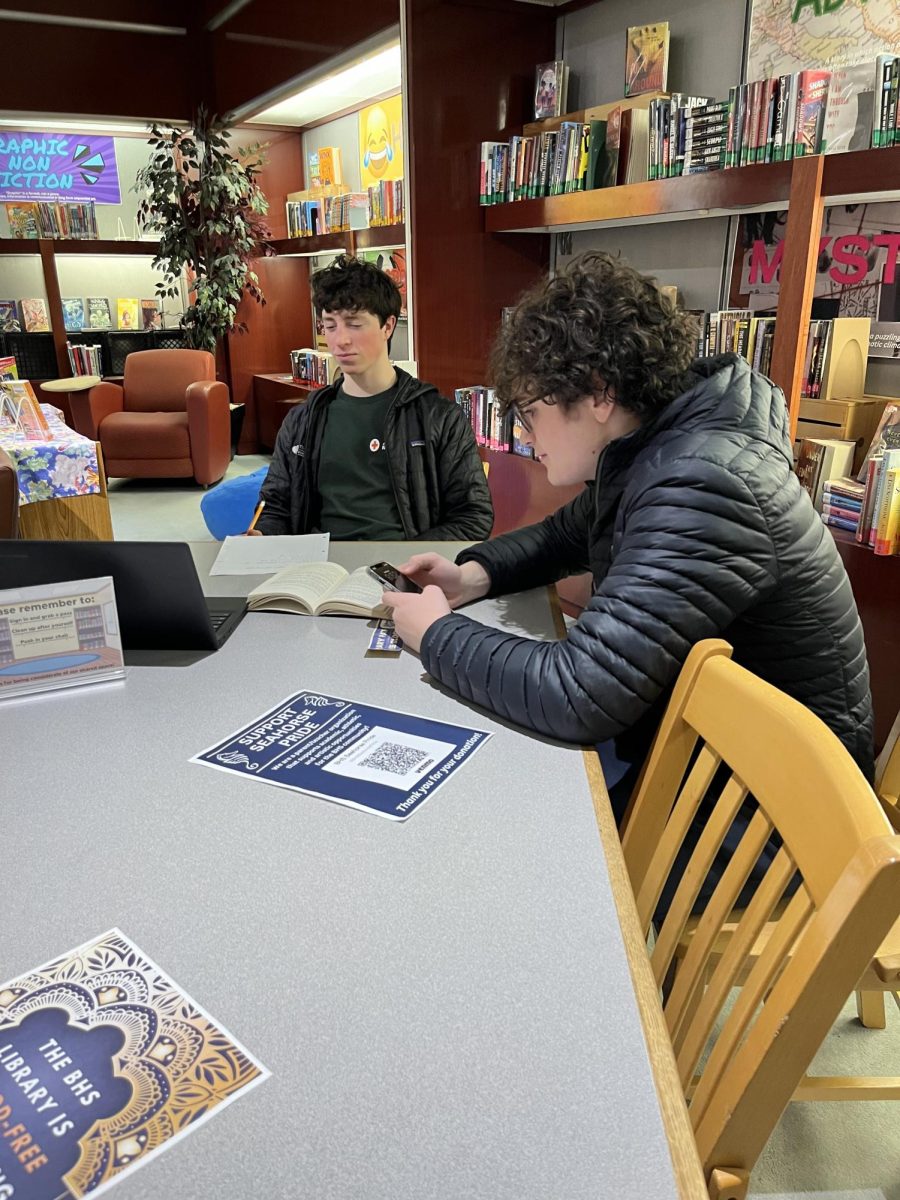
Harper Roof ‘27 said that her phone use at school before the ban was an issue.
“Sometimes [before the phone ban] I would come to the library to do work, and then just like, end up on my phone scrolling. [The phone ban has] led to me being a bit more productive with my work time,” Roof said.
In a Register survey of 108 students, 21% said that the phone ban has made them more productive during class. Data from Knowledge at Wharton shows that without phones in schools, students have a higher productivity rate and higher test scores.
Matthew Price, is a member of the school board and a psychology professor at UVM. Price said people really struggle with knowing when to stop.
“For platforms like X, Instagram, Snapchat and Tiktok especially, there’s never a little pop-up that’s going to appear and say you’ve seen all the TikToks. It’s just going to keep going,” Price said. “And so you sort of are dependent upon your own sort of internal awareness to say, I think I’ve had enough.”
Price explained that even just having your device near you compels you to want to look at it, and if the device isn’t near you or is inaccessible, there is less of a desire to use it.
Welsh agrees.
“Just knowing that it’s in my pocket, or like on me in general can distract me from class,” Welsh said.
In the same Register survey, 35% of students said a benefit of the ban is having more face-to-face interactio754 n.
“My phone helps me to easily contact people, but not having it during school lets me interact with my classmates more, which I enjoy,” Zia Grannis ‘29 said.
However, 48% of students said their stress levels had increased since the ban, which may be related to what students indicated as one of the biggest downsides: “loss of music/relaxation”.
In addition, 21% of students surveyed said that the new policy has actually increased their doomscrolling outside of school.
As BHS prepares to move into its new building next fall, the phone ban may be one less transition to manage, but how students adapt to it over time is still an open question.