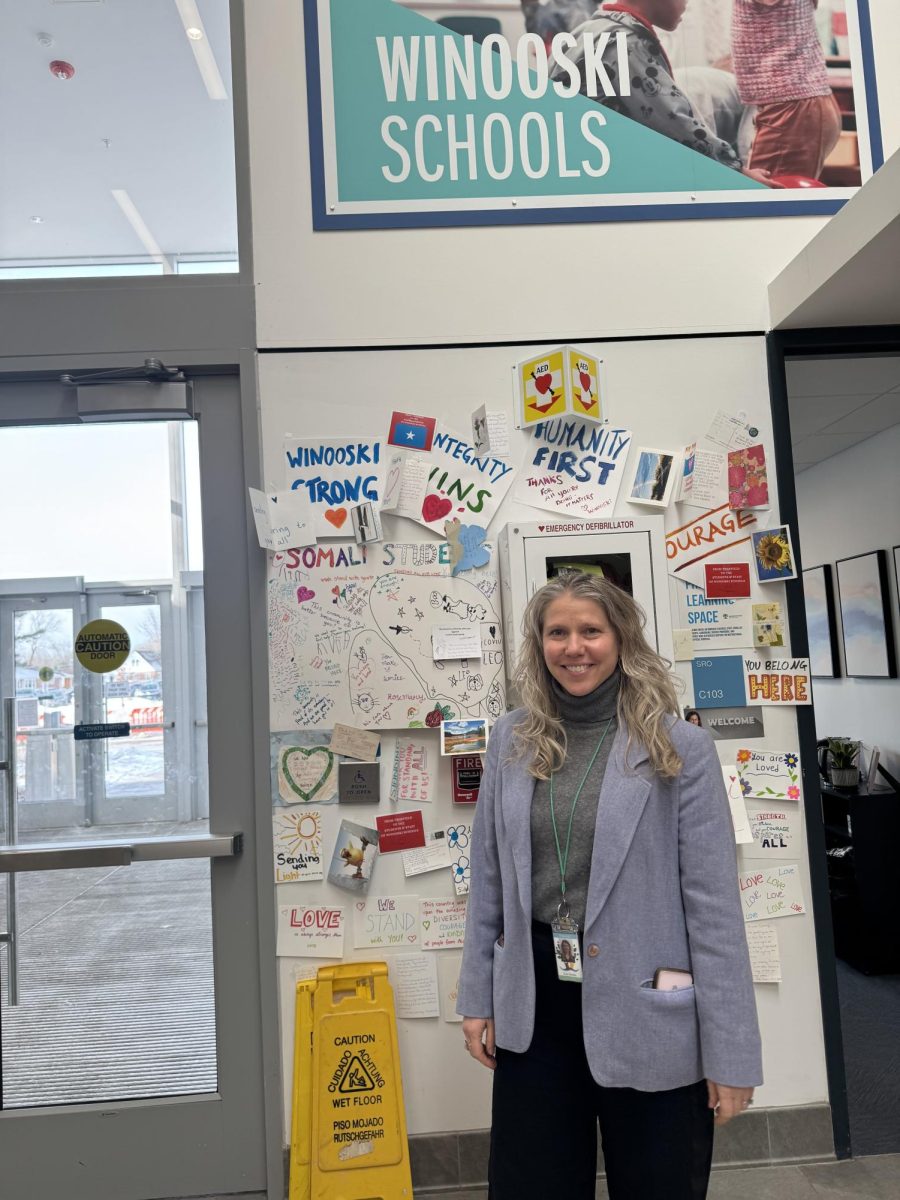
In December, U.S. President Donald Trump called Somalia a “s**thole” country and its people “garbage.” In response, staff and students at Winooski Middle & High School raised Somalia’s national flag. Almost ten percent of the school’s students are from Somalia, and approximately twenty percent of the city of Winooski’s population is made up of refugees.
This flag-raising put Winooski into national headlines. Then the death threats came. After conservative news outlets and influencers picked up the story, people from across the country started making “racist and hateful” calls to the school.
Nearly a year before the raising of the Somali flag, in February of 2025, Winooski held a school board meeting attended by over 120 people where the school district passed a seven-page “sanctuary school” policy – a detailed public statement with the intent of protecting students from federal agents during the school day.
Five months later in July 2025, Winooski Superintendent Wilmer Chavvaria was detained at a Houston airport while returning from visiting family in Nicaragua. The story caught national attention, particularly after Chavvaria testified on Capitol Hill about his “abusive interrogation,” according to reports from NBC5.
“Being detained allowed me to experience first-hand the seriousness of the threats and the extent to which the federal government will go to violate the Constitution,” Chavvaria said, “It only increased my conviction that what we are doing is the right thing.”
While Burlington High School also has Somali students, it did not raise the flag of Somalia like Winooski did. Principal Sabrina Westdijk said BHS released public statements supporting and showing solidarity with Winooski.
“There certainly would be an openness to doing something like [raising the Somali flag],” Westdijk said. “We’re just communicating with families, and supporting families and rights in a different way.”
One of the ways BHS has tried to support at-risk communities is to hold workshops with attorneys to inform students and families of their rights.
“Those [workshops] were publicized within our various language communities, rather than broadcast really loudly,” Westdijk said. “We were concerned that people might not come if they felt unsafe.”
Miriam Ehtesham-Cating, director of programs for multilingual learners, says the Burlington School District has been taking an intentionally quiet approach to ICE-related policies.
“If for example we said, ‘we’re having a meeting of all students and families who speak whatever language, at such and such a time on such and such a day’, ICE would come knocking,” Ehtesham-Cating said. “It’s not about not wanting to sound supportive…It’s about protecting people.”
Ehtesham-Cating says she originally thought ICE would never come to Vermont.
“[I had thought] we’re not big enough. We’re not important enough. We’re not diverse enough for them to pay attention to us. I have to say, sadly, I no longer believe that,” Ehtesham-Cating said. “It would take nothing for ICE to come here next.”
Sofiya Rai ‘28 said she wishes there were more information available about ICE and what its agents are capable of. She speaks both Hindi and Nepali at home, and her parents are immigrants.
“My family isn’t that informed on what’s going on,” Rai said.
Rai said it’s hard to explain to her parents that just because they entered the US legally, it doesn’t mean they won’t be detained. Rai said she often feels like the older generation doesn’t listen to her.
“[My friends] were hesitant to go to practice in case something might happen,” Rai said. “Students are feeling scared to even come to school.”
Julia Lusamba ‘28 said that although her family immigrated here legally, she still worries about being targeted by ICE. She speaks French and Lingala at home. She said her parents don’t know how to deal with ICE.
“They’re treating us like we’re not humans,” Lusamba said. “You have the right to stay where you want to be.”
Neither Rai nor Lusamba had heard of the BHS workshops on their rights with attorneys.
“Unfortunately, we do have family members of BSD students who’ve been detained,” BHS’s Miriam Ehtesham-Cating said. “When all this first started happening I said, ‘We have to be quiet.’ And I still feel that way. “
Winooski Superintendent Chavvaria is taking a different approach.
“Publicity is not a factor in the district’s decision-making,” Chavvaria said. “When decisions draw public attention, the district communicates transparently to provide clarity, address questions and ensure families understand the district’s responsibilities as a public school system.”
Kate Grodin is Co-Principal at Winooski High School.
Recently, a crackdown on Somali immigrants by ICE has been happening in Maine. On New Year’s Day, a Somali taxi driver, Hussein Noor Hussein, was detained by ICE near the Burlington airport.
“We are really trying to stay ahead of the curve if possible… I wrestle regularly with how much to be explicitly talking about some of these actions that are happening,” Grodin said. “And how much to stay focused on teaching and learning and supporting kids.”
Grodin gave an example of a time in which it was impossible to separate teaching from what is happening with ICE. Last year, a student got in significant trouble and Grodin was consulting with the family about the consequences. She heard the family admonishing the student, “at this time we don’t need more attention brought to ourselves.”
“There is a heavy weight that is on certain families because of what’s going on right now,” Grodin said.
In a moment where students like Sophia Rai and Julia Lusamba fear that ICE could show up to their school at any time, schools are being forced to choose between speaking out and staying quiet – and living with the consequences of either choice.
Westdijk says that there will always be fear and speculation.
“We view every family and student in our community as an important part of our community,” Westdijk said. “It has not changed that young people have a right to enroll in schools and be educated.”