

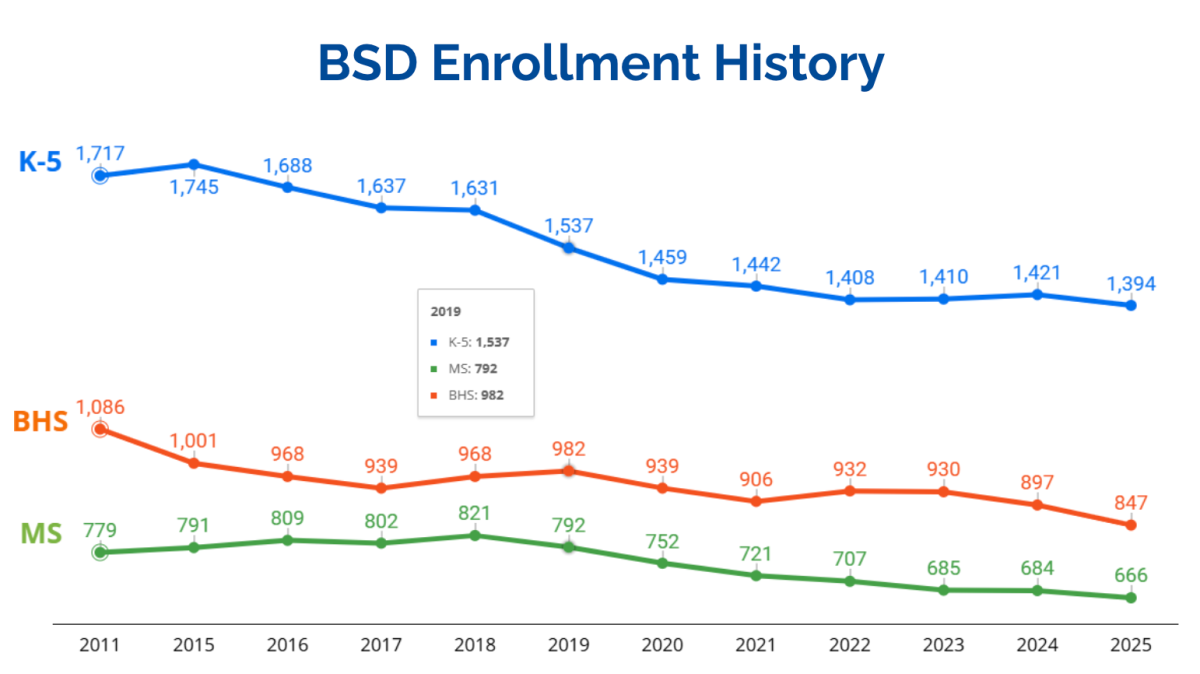
Enrollment at Burlington High School has declined again this year, dropping from 897 students to 847. Enrollment determines staffing and funding through the district’s budget model; the decrease has implications for students, educators and taxpayers.
“On a spreadsheet, we see declining enrollment and reductions in force,” Principal Sabrina Westdijk said. “But in reality, we’re talking about people and colleagues whom people know and trust.”
For students, declining enrollment can affect the number of available courses, class sizes, scheduling flexibility and access to individualized support.
Nadia Comba ‘26 transferred from South Burlington High School. She said there are many more options for classes here at BHS compared to South Burlington.
“I watched a lot of classes disappear and a lot of those classes exist here,” Comba said.
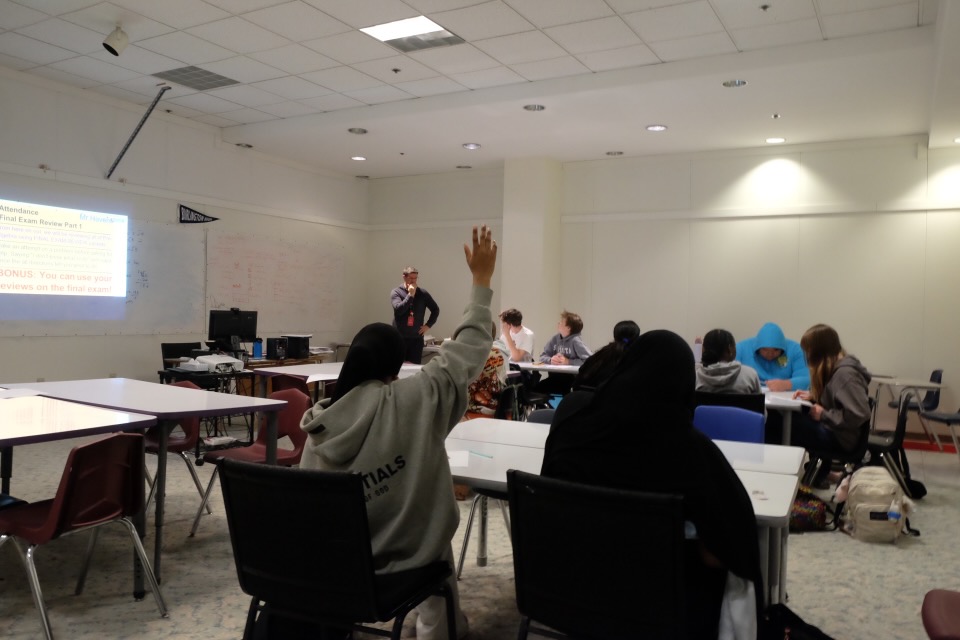
Inside Burlington High School, the enrollment decline is visible in classroom numbers.
“Some classes feel like they’re running smaller than they have in the past, because we have the same amount of staffing as we have in recent years and we’re offering the same number of courses, but there are fewer students to fill those courses,” Westdijk said.
Comba said there were usually 16 students per class at South Burlington, but that “only ten showed up.”
“I think that it’s interesting how the class offering has changed based on what school you’re at, even just a town apart,” Comba said.
As enrollment is declining, Vermont is also implementing new statewide requirements that public high schools maintain an average class size of at least 18 students. Smaller classes will still be permitted in certain exempt areas, including career-technical education, Advanced Placement courses and special education groupings. The State Teachers’ Union has criticized this unfunded mandate, saying it may drive job changes and cuts that may harm schools.
According to Westdijk, staffing decisions are made at the district level using enrollment projections and budget data, then passed on to direct principals to make reductions if any are needed.
The Vermont Department of Taxes’ annual letter, dated December 1, projects that property tax rates will rise by an average of 11.9 percent statewide next year. According to VT Digger, about half of this is due to increases in school district spending and the other half is due to other factors like the loss of the one-time tax reduction funds.
The Burlington Board of School Commissioners Chairperson Clare Wool and Superintendent Tom Flanagan wrote an opinion piece in response to the December 1 letter. In the opinion piece they say the administration has framed the situation as a crisis and used it to justify a proposal to forcefully consolidate Vermont’s 119 school districts into large regional districts.
“Vermont’s schools are not broken; they are under strain. Public education does not need to be taken over. It needs to be strengthened,” Wool and Flanagan wrote in the joint statement.
While leaders argue over solutions, the numbers point to a longer trend that has been unfolding in Burlington for more than a decade. In the early 2010s, BHS enrolled more than 1,000 students. This is a 15% decline in enrollment since then and there is no increase on the horizon.
District data shows that student movement into and out of Burlington has remained relatively stable. The overall decline is tied instead to the number of new families entering the city.
“What we’re learning is that there are no new families, the number of families moving into the city and into the district. We think it’s about access to housing for younger families,” Flanagan said.
According to Apartments.com, the average rent in Burlington is over $2,000 per month, about 30 percent higher than the national average. In addition, Flanagan said that the overall percentage of families that qualify for free lunch has gone up from 50% to 60%.
Mental Health Counselor Ryan Nest helps to distribute the “Seahorse Emergency Fund” to financially struggling students.
“We do have students who are affected by the increase in housing and are at times unhoused or at times have insecure housing and that can put obvious stressors on their basic needs, as well as their ability to access their education,” Nest said.
Another factor influencing enrollment is the change in the number of students arriving from outside the country. Burlington has historically been a refugee resettlement city and immigrant families have played a role in stabilizing school enrollment in past decades.
“We are not having students come to us from other countries anymore,” Flanagan said. “That has an impact and will continue to have an impact on our district.”
Burlington’s new high school building is scheduled to open next year. It will be the first new high school constructed in Vermont in many years and is expected to play a role in shaping future enrollment. While the new building may draw renewed interest in BHS, long-term enrollment trends remain tied to broader statewide patterns like housing affordability, which may take a long time to fix.
“It is so expensive to rent or purchase a home in Burlington that that’s a huge barrier to a lot of families ultimately choosing to live in Burlington, even if they very much want to do so,” Westdijk said.
“What we see is almost an equal number of students coming from Vermont schools into Burlington as are going out,” Flanagan said. “What we are not seeing is the number of students registering and coming into the district.”