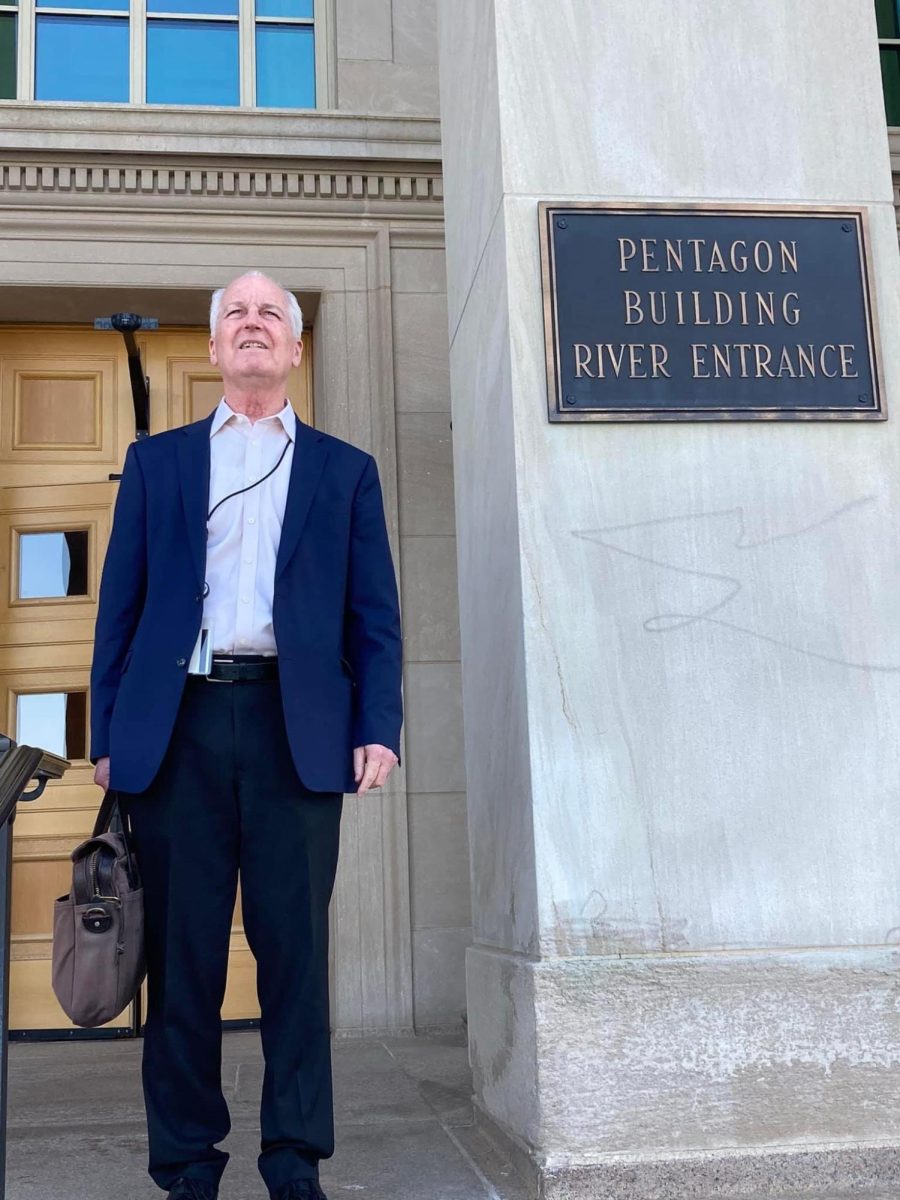
Pete Hegseth and his team said the press corps had an October 15th deadline to agree to the policy, and on this day, nearly every credible news organization turned in their press passes and walked out.
The policy requires journalists to agree to only publish content approved by the Pentagon, including unclassified information. If they refuse, journalists will need to turn in their press credentials, losing access to the nerve center for the United States military. The New York Times is suing the Pentagon over this execution of prior restraint -the government censoring the press before publication- a method deemed highly unfavorable in the 1971 SCOTUS case on the Pentagon Papers.
Student Reporting
Maddie Ahmadi started the Essex High School paper, The Hive and is now in her last year at the University of North Carolina at Chapel Hill. Before The Hive, school information came exclusively from a district newsletter.
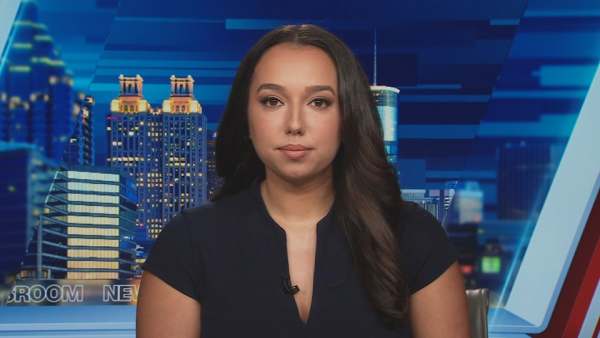
“I really value the news in society, and to me, it felt like the present country,” Ahmadi said. “That’s not how we consume news, that’s not how we build a strong democracy, and that’s not how we would build a strong school community.”
Ahmadi double-majored in Journalism and Peace, War and Defense. Right now, she is working on a Carolina Week special edition that will air in the spring on generative artificial intelligence and the future of journalism. An AI bot will be part of the special and available for viewers’ use.
The state legislature directly impacts the University of North Carolina. The state has a Republican supermajority, which is very different from Ahmadi’s home state, VT.
“Anytime I report on the university I attend, I, of course, cannot be 100% unbiased,” Ahmadi said. “As people, we carry opinions and experiences and values that shape who we are. Explicit bias, however, I do think, is something reporters and journalists are responsible for minimizing. I think that it’s a core element of our democracy and our free press.”
Ahmadi did say she sees value in alternative sources of news. The Call Her Daddy podcast with Alex Cooper was an important milestone in Kamala Harris’s presidential campaign. Though he’s criticized Donald Trump recently, The Joe Rogan Experience was influential in Trump’s 2nd campaign.
“I will also say that those siloed areas can be so niche that they fail to let in any other storytelling,” Ahmadi said.
Student Vermonters are learning to approach journalism with traditional principles and curiosity about how to carve out a unique space for their reporting. Erin Kranichfeld is the Essex paper, The Hive’s advisor and teaches what she feels journalism should be: truth reporters.
“Obviously, as a journalism teacher and as someone who cares deeply about our community in this country, it’s scary right now what’s out there. I’m disappointed at even some of our national papers, just the way it feels pretty skewed sometimes,” Kranichfeld said. “It’s our job to be watchdogs and call out people for essentially bad behavior. “
Kranichfeld teaches media literacy to all her students and also acknowledges that the news is changing. She begins each class with a news segment. She teaches journalistic ethics and how to pick which stories work for which audiences. The Hive recently started a Honey Hive at Fleming Elementary and has a partnership with The Essex Reporter.
“We are pretty fortunate here; we don’t have any censorship,” Kranichfeld said. “Our admin team is not reading our articles and telling us what we can publish.”
Seven years ago, BHS was not so lucky. The BHS Register was instrumental in defining what the New Voices Law meant for VT student journalists. The New Voices Law says that student newspapers have the same rights of a free press, and the advisor cannot be disciplined for refusing to censor the paper.
The Register published a story exposing guidance counselor Marcio Macias’s professional misconduct and interim principal Noel Green censored the paper. Under Beth Fialko- Casey’s leadership, the team then assisted in developing an ongoing district policy that implemented the New Voices Law.
“I gave a courtesy call to the principal at the time, 10: 30 at night, and said, just so you know, this just happened, you’re gonna wake up to the press,” Fialko-Casey said. “He was furious, but I didn’t care. So in the morning, it was a hulla balloo. I was told to tell them to take it down. I didn’t really know how to navigate the situation. I can actually see us in the old building, in the C building office.”
Fialko- Casey recalls later taking down the initial post and deciding to consult the Student Press Law Center before moving forward. She regretted this, but felt good about the thoroughly finished article that was published later. The published article can be found here.
“I felt really good about my community. We can trust our students to measure right from wrong, to report the facts objectively. We can trust their advisor to advise with integrity,” Fialko-Casey said. “I think when you pass laws or policies that reduce that, you’re essentially sowing distrust and you’re undermining learning and education and democracy. And of course, that’s the goal of a fascist government.”
The Pentagon and the Associated Press
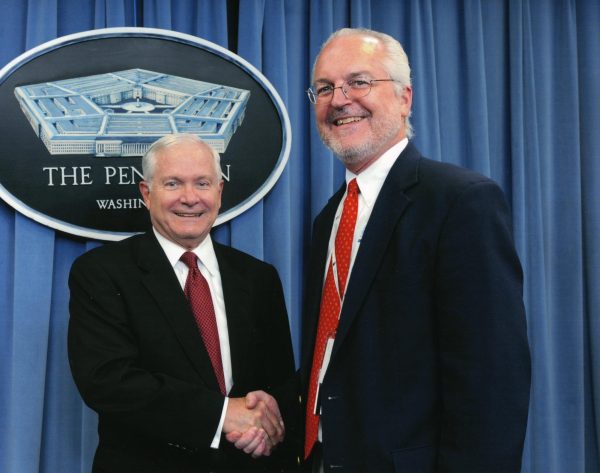
Robert Burns is a past president of the Pentagon Press Association and an Associated Press retiree since 2022.
“I really think that this whole move attempting to limit the coverage of the Defense Department is based on some sort of, I would call it an irrational mistrust, even a hatred,” Burns said. “In my opinion, it’s derived from President Trump’s false claim that the press is the enemy of the people.”
The Trump administration has suggested that media with “bad publicity towards him” should have their broadcast license revoked. But Burns believes broadly that journalism should be about truth-telling.
“The role of the press is to be a watchdog on the government, to hold its feet to the fire, to make it accountable for its decisions and actions,” Burns said. “What the Pentagon is trying to do now is turn the Watch Dogs into lapdogs.”
There is a new exhibit in the library at the National Press Club in Washington DC that features memorabilia and items that were in the Pentagon press room since it first opened in 1943. Though the Pentagon coverage has fluctuated over the course of Burns’ career, this is unprecedented.
Many organizations, such as The Associated Press, CNN, The New York Times, Fox News, NPR and NBC, left the Pentagon, but some remain. The organizations that signed the policy and agreed to the Pentagon’s rules include the Gateway Pundit, National Pulse and Turning Point USA (frontlines).
Traditional journalism follows a code of ethics and is defined by accuracy and impartiality. The concept of New Journalism is often defined by smaller or individual sources, and the reporter’s role is interspersed in the story. Without the code of ethics, there is sometimes more subjective language and clearer bias.
The traditional journalism approach is one that has come into question as new generations shape how mass media is consumed and what is effective, as many people are feeling disillusioned with the mainstream media. More and more young people are turning to social media for independent reviews of current events and some even appreciate the more opinionated creators.
“I think people turn more towards it, just because it’s more accessible. I also think if you see someone that is in a similar circumstance that you are, that you’re more likely to trust them, whether you know them or not,” Nadia Comba ’26 said. “I think there’s automatically, this established, like, we’re on the same side. They’re finding more community in it.”
Dave Bauder is a current media reporter with the Associated Press. The Associated Press is one of the top non-biased and factual news organizations in the world. Bauder was clear that he stands by this.
“There are certain organizations where they see [activism and politically biased reporting] as their role. It’s not something that my organization sees as its role at all. And you know, there’s, there’s room for a lot of different people,” Bauder said.
Bauder receives emails from many people who disagree with what he writes and he does his best to respond to them. He believes in strong dialogue.
“I mean, you’ve seen all the stories about restrictions that have been put in place, and some criticisms of the press by the administration,” Bauder said. “I think the Defense Secretary follows the lead of what the President has been doing. A lot of critics see it as being extraordinarily thin-skinned.”
Vermont Journalists
Scott Finn is a professor at the University of Vermont and helps to run and edit the Community News Service, a publishing hub for the university’s papers. He reported in West Virginia and Florida before moving to VT to run Vermont Public Radio. He believes that journalism provides the accountability that institutions and government need.
Finn covered a story in a West Virginia school district in 2001. He exposed the public corruption by the assistant superintendent Glenn Allen McClung. After a flood wiped out schools in McDowell County, the district had to replace school furniture.
“GA McClung turned to his friend, Philip Booth, whose nickname, by the way, is Pork Chop. He said, Pork Chop, can you buy me the furniture? GA McClung got a kickback. In other words, he got money and gifts from Pork Chop Booth in exchange for giving him that [district] contract,” Finn said. “If we had to sign some sort of loyalty pledge to cover the state government, we couldn’t have done that story right at all. There was a lot of accusations that it was fake news. But later, GA McClung was indicted by federal officials and found guilty of fraud.”
Matthew Roy is the News Editor for Seven Days VT. He gave his perspective on the Pentagon’s press policy and on journalism’s future in VT. Roy spoke about journalists uncovering scandals and referenced Seymour Hersh and the Mai Lai massacre during the Vietnam War, the Pentagon Papers, the Abu Ghraib Prison in the Middle East/ Iraq. His point: the business of journalism is asking questions.
“[The policy says] if you’re a real reporter, you shouldn’t be here, because real reporters have to ask the hard questions that he doesn’t want to hear and doesn’t want to have to answer,” Roy said. “If we didn’t have that ability to communicate like that, you would never know anything other than what the government wants to tell you.”
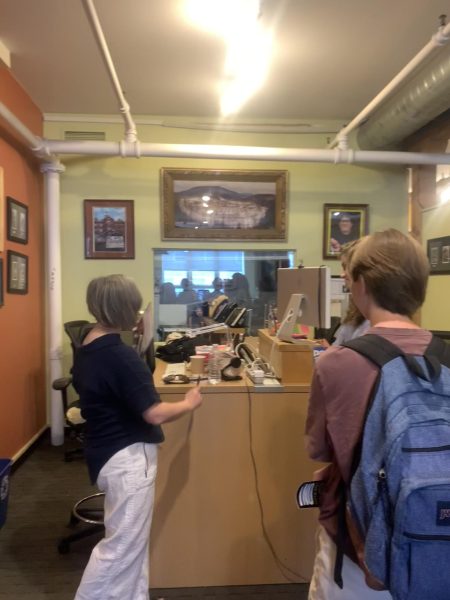
Cathy Resmer giving a tour of Seven Days to the Green Mountain Summer Journalism Institute
(Rose Howell)
Finn emphasized the importance of local organizations in rebuilding trust between the public and the press. The University of Vermont is part of a national effort to have more college students participate in community reporting. There are 172 colleges and universities across the country doing this. Finn believes this is valuable because it builds a strong base of local community reporters.
“I don’t want you to trust the media. I want you to trust me. Here’s how I work. I think journalists need to re-earn the trust of the public by doing their jobs fairly and accurately and correctly, and I think the public needs to support journalists in doing that job,” Finn said. “[They] need to understand that journalists are there to basically be their eyes and ears. Then, we need to start electing people that, they might not love the media, but they respect it, allow it to do its job and understand that journalists have a place in protecting America.”